Payments
Adyen payments
Connect Adyen terminals, payment links and saved cards to Renteon: set up the webhook, take payments, block, charge and release deposits, and charge cards later.
Last updated
Adyen is an international card payment platform with its own terminals. When Adyen is connected, Renteon's payment form sends the amount straight to the Adyen terminal on your desk and reads the result back. The same connection blocks deposits on the card, charges or releases them when the car comes back, charges a card the customer used before (without the card being present), and lets customers pay online through a payment link, after which Renteon creates the document by itself.
Adyen is available in every country. It works only when its webhook is set up: Adyen confirms many things later, by sending a notification to Renteon, and the webhook is the address it sends them to.
What Adyen does in Renteon
- POS terminal payments on Adyen terminals connected to Adyen's cloud.
- Pre-authorization (deposit): the amount is only blocked on the card. This works on the terminal, with a saved card and through the deposit payment link. Adyen has to allow pre-authorizations on your merchant account.
- Capture: when you charge a deposit, Renteon asks Adyen to take the amount of the bill from the blocked money.
- Release: when you return a deposit, or cancel the deposit document, Renteon asks Adyen to cancel the pre-authorization.
- Saved cards: Adyen keeps the cards of your clients. A card is saved when it is used on a terminal from Renteon, or when the customer agrees to it on the online payment page. You can charge a saved card later, for example for a fine or damage found after the rental.
- Payment links: the customer pays the booking, or the deposit, on Adyen's payment page.
- Transaction search: you can attach an Adyen transaction that already happened to a payment in Renteon.
Not supported: refunds (Renteon never sends money back; refund in Adyen's Customer Area) and deleting saved cards from Renteon. Payments that someone starts directly on the terminal, without Renteon, are not recorded in Renteon.
What you need from Adyen
From your Adyen account (the Customer Area) you need:
- the name of your merchant account;
- an API key. It must be allowed to make the calls Renteon uses: payments and payment links, managing webhooks and, if you use terminals, Adyen's terminal API. Ask Adyen if you are not sure the key has these permissions;
- for the live system, the live URL prefix, shown in the Customer Area under Developers, API URLs;
- the device ID of every Adyen terminal, for example V400m-346543275;
- pre-authorizations switched on for your merchant account, if you want to take deposits.
For testing you need an API key of Adyen's test system, because Renteon's Test mode works with that system. For payment links you also need the online check-in site, because the payment page the customer opens is part of it; ask Renteon support if your links do not open.
Switch Adyen on and connect the webhook
You need the role Application settings management to change the settings and to use Enable Webhook and Test Webhook here.
- Go to Administration → Code book → Settings and click Edit.
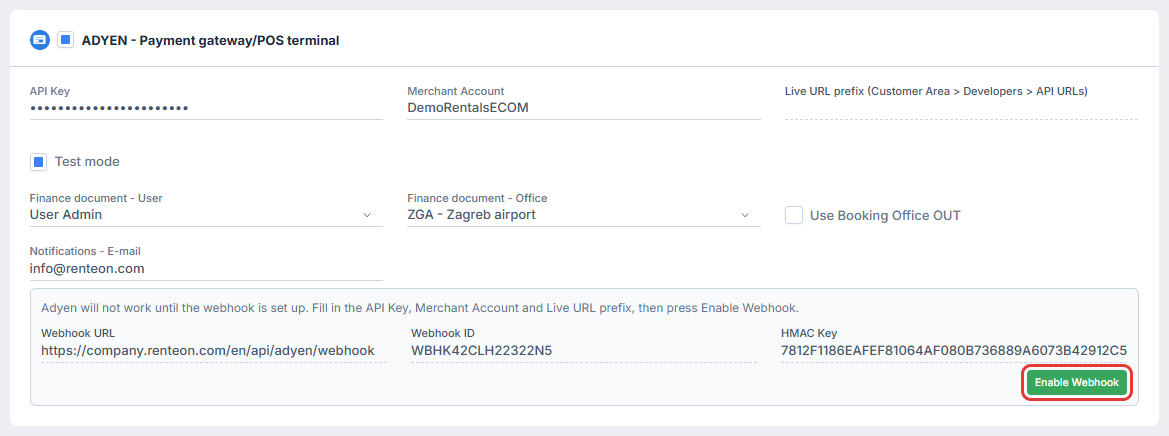
- Open the tab Payment module and tick the box in the header of the panel ADYEN - Payment gateway/POS terminal.
- Fill in API Key and Merchant Account.
- For the live system, leave Test mode unticked and fill in Live URL prefix (Customer Area > Developers > API URLs). For testing, tick Test mode: the prefix field is then greyed out and not needed.
- Fill in Finance document - User, Finance document - Office or Use Booking Office OUT, and Notifications - E-mail (described below).
- In the webhook box ("Adyen will not work until the webhook is set up."), click Enable Webhook. The button stays greyed out until API Key and Merchant Account are filled in. Renteon registers its Webhook URL at Adyen, or reuses the webhook that is already there, and fills in Webhook ID and HMAC Key. A message tells you whether the webhook was created or reused and whether a new HMAC key was generated, and reminds you to save.
- Click Confirm. The settings cannot be confirmed while Adyen is switched on and the HMAC Key is empty, so Enable Webhook always comes before Confirm.
- Now, outside edit mode, click Test Webhook. Adyen sends a test notification to Renteon. "Webhook OK" with Adyen's response time means everything works.
The fields:
- API Key: your Adyen API key, masked on screen.
- Merchant Account: your merchant account name.
- Live URL prefix (Customer Area > Developers > API URLs): the prefix of your live endpoints. You can paste the whole address from the Customer Area; Renteon keeps only the prefix.
- Test mode: when ticked, Renteon works with Adyen's test system. The live system can only be used on Renteon's production server; elsewhere Renteon refuses with "Adyen live works only on the production server. Switch on Test mode and enter a test API key."
- Finance document - User: documents that Renteon creates by itself after an online payment are issued in the name of this user and go into this user's cashbook. The user needs at least one active office with a cashbook that does not have Disable billing ticked (Administration → Code book → Users, panel Cashbook), otherwise the payment page cannot open.
- Finance document - Office: those documents are issued in this office. You can only choose an office where the selected user may keep a cashbook. Required unless Use Booking Office OUT is ticked. If an office has an Invoicing office set (Administration → Locations → Offices), the document is issued in that invoicing office instead.
- Use Booking Office OUT: when ticked, those documents are issued in the pick-up office of the booking instead.
- Notifications - E-mail: the address that receives Adyen problems: a capture or release that Adyen refused, a document that could not be created, a notification that could not be processed or had a wrong signature. Several addresses can be separated by a comma or a semicolon.
- Webhook URL: Renteon's address for Adyen's notifications, shown for information. Webhook ID and HMAC Key are filled in by Enable Webhook; only Renteon support can change the HMAC Key by hand.
The user and office fields have no effect on payments you take yourself on the terminal or with a saved card: those go on the document you are working on, in your name and your office.
Warning: If Test Webhook reports that the HMAC key saved in Renteon is not the one Adyen signs with, every notification from Adyen is ignored: online payments create no documents and refused captures are not reported. Contact Renteon support to empty the HMAC Key field; then click Enable Webhook again, Confirm and test again.
Companies with their own Adyen account
If your Renteon account has several companies, each can have its own Adyen merchant account. Open Administration → Code book → Companies (shown only in accounts with several companies, and only to users with the role Company editing), open the company and fill in its ADYEN - Payment gateway/POS terminal panel the same way, including Enable Webhook and Test Webhook. Companies that share one merchant account also share one webhook and its HMAC key; Enable Webhook takes the existing key over for them.
Renteon always uses the settings of the company of the document, booking or POS. The panel in Settings is used only for documents, bookings and POS entries that belong to no company, so in an account with several companies switch Adyen on in every company that uses it.
Renteon uses only one gateway for payment links per company. If more than one is switched on for the same company, the payment page uses RedSys first, then Monri, Windcave, Adyen and Stripe.
Payment types and permissions
In Administration → Code book → Settings:
- Tab Code book, panel Payment type: tick Adyen (charges to saved cards and captured deposits use it) and Credit card - preauthorisation (deposits taken on the terminal use it), besides Credit card.
- Tab Finances, panel Finances: if Credit card tokenization use restricted is ticked, only users with the role Finance document credit card tokenization use may use saved cards: choose the Adyen payment type on a new document, charge a saved card, and return or cancel deposits. While Adyen is switched on this applies to every deposit of the company, also one paid in cash. Give that role to the people who settle rentals.
Taking payments and returning or charging deposits also needs the role Invoice management, as for any other document.
Add your Adyen terminals to the POS list
You need the role POS for this screen.
- Go to Sales → Cashbook → POS list, add a new POS or open one, and click Edit.
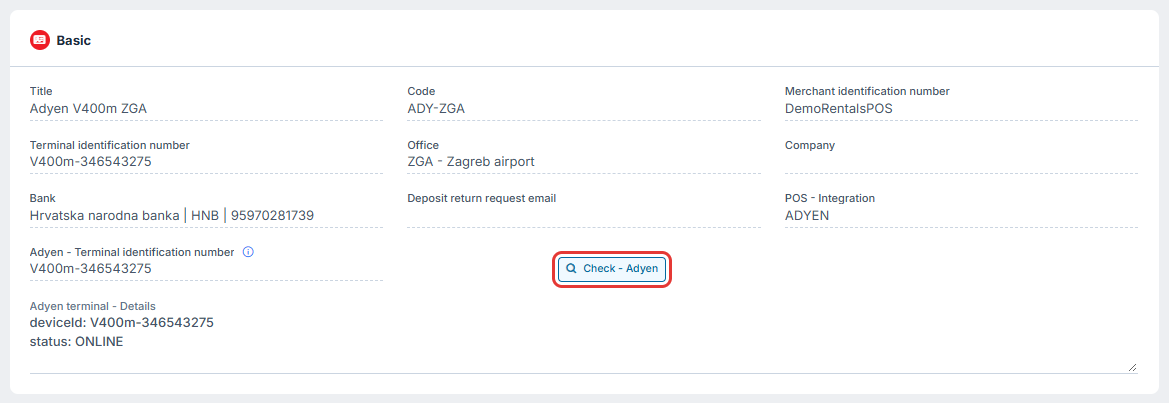
- Fill in Title, Code, Office and Bank as for any POS. Renteon sends the POS Code to Adyen with every terminal transaction. Choose the office where the terminal really stands: a payment offers only the terminals of its document's office. In an account with several companies, give the POS the company whose Adyen account the terminal belongs to: Check - Adyen uses the settings of the POS's company, a payment those of the document's company, and a payment offers only the terminals of its own company.
- In POS - Integration, choose ADYEN. The field is only shown while a gateway with terminals is switched on for the POS's company.
- In Terminal identification number, enter the terminal's device ID from Adyen, for example V400m-346543275. It is required as soon as an integration is chosen.
- Click Confirm.
- Outside edit mode, click Check - Adyen. Renteon asks Adyen whether the terminal is connected and shows the answer under Adyen terminal - Details. "Status: ONLINE" means the API key, the merchant account and the device ID are right and the terminal can be reached. If the check fails, the reason (for example a key without permission for terminals) stays in that box.
Take a payment on the terminal
- Create the document as usual, for example from the booking's Actions menu with Create an invoice, or on the Close contract screen.
- In the Payments section, click Add payment, choose Credit card as Type and the Adyen terminal in POS.
- Check Client - Card holder. Renteon fills in the client of the document. A terminal transaction cannot start without a client, because Adyen saves the card for this client.
- Check the Amount and click Charge - POS.
- The dialog POS - Transactions (Adyen) shows "Complete transaction on POS terminal." Let the customer pay on the terminal.
- Click Check - POS Result. While the terminal is still busy, Renteon shows the status "InProgress"; click again a little later.
- When Adyen authorises the payment, the dialog closes and Renteon fills in the card number, authorization number, validity, card type, card holder (the client's name) and Transaction ID (Adyen's reference), plus the slip data. If Adyen approved with a remark, the remark is shown in a message.
- Click Confirm in the payment dialog and save the document.
If the terminal refuses the card, the dialog shows Adyen's reason. The payment stays empty; close the dialog with Cancel and start a new transaction or choose another payment method.
Warning: The money is taken the moment the customer pays on the terminal, before you save the document. If you close the document without saving it, the customer has paid and there is no invoice. Create the document again and attach the payment with the transaction search (see below) instead of charging the card a second time.
Block a deposit on the card
On the booking, open Actions and choose Credit card pre-authorization. The menu item is there until the deposit is paid, and not for bookings without a deposit.
In the first step of the new document, check the Currency. Renteon preselects your domestic currency, or the booking's deposit currency if Use deposit currency for credit card preauthorization is ticked (Settings, tab Finances, panel Finances). Adyen is charged in the currency of the document.
Then block the amount in one of two ways:
- On the terminal: add a payment with type Credit card - preauthorisation, choose the Adyen terminal in POS and click Preauthorisation - POS.
- On a saved card: add a payment with type Adyen, choose the card in Select Credit card and click Preauthorisation.
Confirm the payment and save the deposit document. Use Credit card - preauthorisation for terminal deposits: Renteon turns exactly this type into an Adyen payment when the deposit is charged later.
Charge a saved card
- In Add payment, choose Adyen as Type and check Client - Card holder.
- Select Credit card lists the cards Adyen holds for this client, with the card number's last digits, expiry date (an expired card is marked) and card holder. The refresh icon reloads the list. Pick a card.
- Click Charge Credit card (on a deposit document the button is called Preauthorisation).
- A dialog shows the client, the amount and the card. Click Charge (or Preauthorisation). Renteon shows a wait message while Adyen processes it.
- When Adyen authorises, the card data and Transaction ID are filled in. Confirm the payment and save the document. If Adyen refuses, the message "Adyen did not approve the payment" with Adyen's reason is shown and nothing is filled in.
If the connection to Adyen breaks during a charge, Renteon checks whether Adyen confirmed the payment in the meantime and, if so, treats it as successful. If Adyen confirms a charge only after Renteon has already shown it as failed, a message "Adyen charge confirmed after it was reported as failed" goes to Notifications - E-mail. Check that message before you charge the card again.
Charge the deposit when the car comes back
- On the booking, open Actions and choose Charge under the deposit's heading, or click Charge on the Close contract screen next to "There are unprocessed deposits on this contract. Please select an action.". Answer Are you sure? with yes.
- Renteon opens a new bill for the booking. Its payment is taken from the deposit: an Adyen payment with the deposit's Transaction ID.
- Open the payment and check the Amount. Renteon proposes the smaller of the blocked amount and the amount of the bill. Renteon accepts any amount above zero up to the blocked amount.
- Click Preauthorisation - Charge, check the Transaction ID and amount in the dialog and click Charge.
- You see "Transaction completed.", and only now can you confirm the payment. Save the bill.
Adyen's capture is confirmed later. Renteon treats the capture as done as soon as Adyen accepts the request; the final answer arrives through the webhook a little later. If Adyen refuses it then, a message with the booking, the reference and the reason goes to Notifications - E-mail. Its subject is "Adyen capture failed", or "Adyen cancel failed" when Adyen reports the refusal as a failed capture; in both cases the text names the booking. The bill may already show the deposit as charged, so check it and settle the amount another way before the pre-authorization expires.
Some refusals come at once and are shown in the dialog: the pre-authorization was already cancelled or already captured, an earlier capture is still waiting for Adyen's confirmation, or the amount is above the blocked amount.
A charged deposit cannot be returned in Renteon afterwards ("This deposit is already withdrawn."), and Renteon sends no separate release for the part of the blocked amount that was not captured. Ask Adyen how the rest of a partly captured pre-authorization is treated on your account.
Charge works this way only for a deposit that was taken through Adyen. For any other deposit, or when Adyen is switched off for the company, Charge first returns the deposit and then opens the new bill with the deposit's payment copied as an ordinary payment; nothing is sent to Adyen.
Warning: The capture is sent to Adyen when you click Charge, before the bill is saved. Always confirm the payment and save the bill afterwards.
Release the deposit
When nothing is to be charged, click Return for the deposit, on the booking (Actions, under the deposit's heading) or on the Close contract screen. Renteon issues the deposit payout document and asks Adyen to cancel the pre-authorization. Cancelling the deposit document has the same effect.
Request deposit return is not needed for an Adyen deposit: it only sends an e-mail to the Deposit return request email address of the POS, while Return already asks Adyen to release the money.
Like a capture, the release is confirmed later through the webhook. If Adyen refuses it, "Adyen cancel failed" goes to Notifications - E-mail. If the request cannot even be sent, the payout document is still saved, the deposit stays blocked on the card, and "Renteon - Adyen void transaction error" goes to the same address. In both cases release the amount in Adyen's Customer Area.
Payment links
When Adyen is switched on, every reservation and contract has payment links:
- In the booking's Links menu (users with the role Create and modify bookings): Online payment link (everything still to be paid) and Deposit Payment Link (the deposit, blocked on the card). The copy icon copies a link.
- In e-mail templates: the keywords OnlinePaymentLink, OnlinePaymentLinkDeposit and OnlinePaymentLinkPercentage20 (20% of what is still to be paid), shown between underscores in the template editor. See Automatic email sending.
- A website or another system connected through Renteon's External API receives the same three links with each reservation and contract.
The customer opens the link, enters the billing data (a company with its VAT ID, a person with their surname), clicks the pay button and pays on Adyen's page, in the booking's currency. Adyen asks the customer whether the card may be saved for later. Adyen's payment page is valid for one day; after that the customer opens your link again. If a card is declined, the customer can try another one on the same page.
The document is created only when Adyen's notification arrives through the webhook; the confirmation page the customer sees afterwards does not create anything. Renteon then creates, in the name of the user and in the office from the settings:
- for a payment: an invoice with an Adyen payment and the remark "ADYEN payment". If the customer is a person and Disable invoice entry for individuals is ticked (Settings, tab Finances, panel Finances), Renteon issues a bill instead of an invoice;
- for a deposit: a deposit document with the remark "ADYEN preauthorization", which you later charge or return as described above.
The document carries the card data, the authorization number and Adyen's reference in Transaction ID. Adyen may send the same notification more than once; Renteon creates only one document per payment. If the document cannot be created, "Adyen payment - error" goes to Notifications - E-mail with the booking, the reference and the amount.
Find an earlier transaction
If a payment happened at Adyen but is missing in Renteon, attach it instead of charging again:
- In Add payment, choose the type (Adyen, or Credit card with an Adyen terminal) and the client.
- Click the search icon next to Transaction ID (Search Transaction ID).
- The list Transactions - Adyen shows the client's Adyen transactions with date, type (POS for terminal, LINK for payment link, MIT for a charge to a saved card), status, amount and currency, the document they are already on, whether it was a pre-authorization and the card. Under each row you see Adyen's reference, the booking and, for refused attempts, the reason. Click Select on the right one.
Check the document number column first: a transaction that already belongs to a valid document must not be attached a second time. If the client has no Adyen transactions, Renteon only shows "No transactions found." and no list opens.
When something goes wrong
- "Adyen is not enabled.", "Adyen API key is not set in the settings." or "Adyen merchant account is not set in the settings.": check the panel of the company the document, booking or POS belongs to.
- "Adyen live URL prefix is not valid.": copy the prefix again from the Customer Area, under Developers, API URLs.
- The terminal never reaches the customer: click Check - Adyen on the POS. Anything other than ONLINE means the terminal is not connected to Adyen.
- "Processing POS terminal requires client!" or "POS terminal transaction requires a client.": choose the client in Client - Card holder.
- Online payments create no documents, or refused captures are never reported: run Test Webhook. Messages "Adyen webhook - bad signature" or "Adyen webhook - processing failed" in your mailbox point to the same problem.
- "The usage of tokenized credit cards is restricted for this user": the user needs the role Finance document credit card tokenization use.
- The customer sees "Unfortunately your booking cannot be found" although the booking exists: check that the booking is not cancelled and that Finance document - User is set and may keep a cashbook in an active office.